A Post From CFHI’s Medical Director:
I’m just returning from conducting a workshop at the NEGEA Regional Conference. NEGEA is the Northeast educator’s chapter of the AAMC – a gathering of the people who oversee medical student and resident education. Just like many in global health medical education, they are grappling with how to get their hands around the subject and figure out how to increase collaboration.
I was pleased at the warm reception of my presentation on developing global health curriculum and engaging in partnerships for global health rotations. I was equally as pleased to present under the auspices of the conference title “International Health.” The AAMC shared their project GHLO (Global Health Learning Opportunities) which is currently in a pilot stage. They hope to create a program to facilitate global health rotations. I commend them on this important effort and for the embrace of ‘international health’ as the subject of the regional meeting. However, I hope this and other new initiatives doesn’t distract from the AAMC and similar bodies from doing what they know how to do, have done for years, and have the power to do- INFLUENCE THE REQUIRED CURRICULUM AT US MEDICAL SCHOOLS BY MAKING BASIC GLOBAL HEALTH KNOWLEDGE A REQUIREMENT FOR EVERY STUDENT GRANTED AN MD IN THE US.
Issuing a Challenge to Medical Educators and Associations
I challenge the community of medical educators and colleges (AAMC), licensure (LCME) and evaluation bodies (NBME) to consider how much power they wield to make a difference for patients of ‘global health’ and the inadequately numbered workforce that takes care of them (don’t worry, US doctors are not going to abandon US patients when they find out about suffering abroad; US doctors are not the answer to workforce challenges in developing countries…even though many of us would like to be). However, US doctors can be informed and empowered as advocates for the political, socioeconomic, health systems change and skills transfer that are needed to address global health inequities, as well as embrace global citizenship in both their professional and private lives. The AAMC, LCME, and NBME have the power to make US physicians learn why the majority of patients suffer in the world. We must consider ourselves part of the larger world because diseases don’t respect borders, and ‘global health’ is actually in all our back yards. Knowing what is going on outside our domestic bubble will only make us better doctors for our increasingly diverse patient population at home. As things are, we graduate from medical school and aren’t required to have the slightest clue.
It is my personal belief that I was cheated at medical school- nobody told me that 15 million children die each year of malnutrition, no one mentioned that the most common cause of death during childbirth is hemorrhage and only 1% of maternal deaths occur in developed countries. No one mentioned the Millennium Development Goals or what DALYs are and why they’re important. I graduated with a MD in the United States without being taught why the majority of people suffering in the world are suffering. This can’t be right.
Yes, there is global health education happening at every medical school in the US (according to most claims and studies, although comprehensive,updated surveys are limited….I’m not proposing that it is a good use ofour time to continue studying this, but rather it’s time to make it happen.) Yet the reality is that most of the global health curriculum at US medical schools is happening informally during lunch-time meetings, in special pathways that ‘preach to the choir’ of students already interested in and fairly astute about global health issues, during limited elective time, or in the context of student-driven interest groups. I am impressed as I travel though meetings of groups that inform medical education- AAMC, CUGH, GHEC, AMA, AMSA, etc. – that people are pretty much on board with the demand of students for global health exposure. I am also impressed with the number of grandiose plans organizations and institutions are formulating to make dents in global health. Yet I’m appalled that these plans seem to overshadow a basic step toward helping the millions of patients dying of treatable and preventable illnesses every year- teaching our medical students about them. The old adage “Ignorance is Bliss” is apropos. If we don’t teach our medical students about suffering beyond our borders, we can’t guarantee they’ll know about it. It also goes that if we don’t test them on it, we won’t necessarily teach them it….this is how the medical education system works. “Knowledge is power” and thus, lack of knowledge is disempowering. By not requiring US medical students to know basic global health topics, we are disempowering them and in doing so contributing to the global health inequities that claim millions of lives a year and cause millions of more to needlessly suffer from disability.
Implementing Change
When I bring this idea to various tables or conference rooms, at least one person says “but what do we teach” and several others nod in enthusiastic agreement with the skeptic. Global health is an amorphous beast in many respects. Luckily, people with more dedicated time and know-how than you or I have given it much thought and come up with competencies for medical students. There are several competency sets out there. One of my favorite sets is by the Joint US/Canada Committee on Global Health Core Competencies.
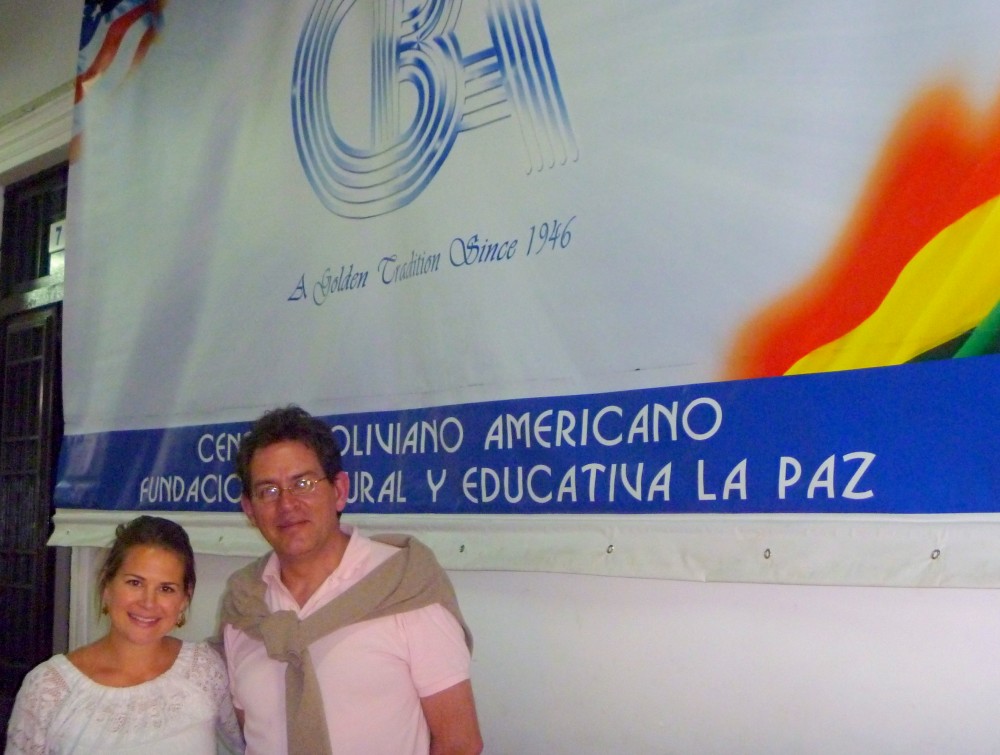
Dr. Evert with CFHI La Paz, Bolivia Local Coordinator
The next challenge to is “who will teach it,” a valid concern. The irony about many faculty who do global health is that they are often somewhere on the other side of the globe for much of the time and unavailable to teach at their home institution. The other issue is that many people who work globally know their niche very well, but don’t feel competent speaking about basic global health topics. For instance, an Obstetrician may work in Eritrea developing an OB/GYN residency, but doesn’t feel comfortable teaching about the Millennium Development Goals or other basic global health concepts. Unlike many other medical school topics (cardiology, immunology, histology, etc) where the information is consistent and the body of knowledge clearly defined, global health is not so clear cut. You can be practicing global health through telemedicine, working with refugees in your community, or training the trainer in Mexico, but that doesn’t mean you understand basic tenants of global health, such as, “Why is the 3rd world the 3rd world?” If you want to find out view the presentation. Point being- faculty doesn’t feel confident to teach global health.
This too can be overcome. Thanks to GHEC, over 75 modules have been developed with extensive notes and soon-to-be-available quizzes. These can be used for self-instruction by students, as a complement to global health courses (such as UCSF’s Global Health 101 course), or can be used to teach faculty the information they need to teach to students. Faculty development is necessary. There are also many others in the community, in schools of public health, nursing, economics, anthropology to name a few, who can be utilized to teach medical students. I know this is complicated with funding streams, schedules, and academic appointments, but if there’s a will, there’s a way. Any faculty who are interested in getting a primer on global health topics and getting more comfortable teaching them can begin by accessing online resources I’ve linked to here.
Next Steps
Hurdles exist, but they are rather low. Students are demanding this reform and faculty are championing it. I think many feel there’s a hang up when “global health” gets to an administrative level. I could go around knocking on deans’ doors, but I’ve got medicine to practice and a family to care for….so I’m asking the AAMC, LCME, and NBME to strategize together or independently about how they can do what they know best and make global health education a requirement at US medical schools. I will suggest some concrete steps that each body can take. These come from my limited knowledge of how they work, and would welcome any feedback from those who understand these processes better or have been involved in influencing them. Email me at jevert@cfhi.org to chat.
- NBME: please establish a writing task force on the subject of global health, similar to what was done for end-of-life care. In addition, recruit individuals to write global health competency based questions for USMLE Step 1 and 2. (I am happy to provide some references of qualified folks).
- LCME: please recognize global health content in satisfying your licensure requirements, perhaps these can be considered under ED-10 as “socioeconomic subjects,” ED-11 as “public health,” or ED-20 as “medical consequences of common societal problems” (Full LCME accreditation requirements).
- AAMC: please utilize the Medical School Objectives Project (MSOP) to promote competencies in global health, recognizing global health as a necessary objective of medical education.
I will make note of an effort at the LCME level (MS-20 proposed at May and Sept 2010 gatherings of the LCME) to require pre-departure training for all medical students undertaking an international electives. This effort is led by Kelly Anderson and Michael Slatnik (two Canadian medical students at the time who are now Family Medicine residents), who successfully advocated for such a requirement at all Canadian medical schools. Such change is very possible, thanks to our Canadian counterparts for paving the way.
AAMC, LCME, NBME, and other powerful entities in medical education- in addition to creating novel new programs, please look at your inherent sphere of influence over medical education and consider leveraging your power to make curricular changes. Require US-trained physicians to have minimal knowledge about realities in disease and healthcare in underserved populations around the world. It is only with such knowledge that we physicians can respond to demands both within and beyond our borders and be effective advocates, colleagues, and caregivers.
Jessica Evert, MD
Medical Director, Child Family Health International
I really appreciated your blog! I could not agree with you more.
It’s important for all citizens of the world to have some kind of curiosity and interest in one another, that we learn together and appreciate each others struggle. Most importantly, as the geographic boundaries are blended through movement of people from one community to another, it is our duty as physicians to have the skills to be able to meet those needs. Not only from a medical standpoint, but culturally as well.
International medicine education needs to be developed passed Instructors simply presenting their own work in a far away community. It needs to be integrated into our everyday learning.
Thank you for bringing attention to this subject!
Thank you Jessica for your honest and powerful post, and for the work you do.
In my opinion, a major hurdle to ‘global health’ being a meaningful component of medical school curriculum is a misunderstanding that it is foreign and other. As a profession, medicine has gradually evolved to move past teaching pathophysiology of disease, to understanding disease in the context of the patient, and to understanding disease in the context of society (public health, ethics); medicine will move to understanding disease in the context of communities and of the world as a whole, with the recognition that the word HEALTH in any other language has the same value and importance. As Jessica described with her feelings of being cheated by her own medical education, in my own MD degree I was not given a proper context of suffering as it relates to marginalized communities in Canada and around the world, and I am left to piece this together on my own. To echo the sentiments of Jessica, Kelly and Shreya, it is worrying that after medical school we can practice medicine in any community or context we like without having had the proper training to prepare us for this.
Although the LCME has not yet adopted the proposal to implement predeparture training as an essential component of service learning, we continue to advocate for this important component of student, patient and community safety. I will join the call for updated LCME requirements to reflect the realities of global health. Thank you Jessica for this important discussion.
I would like to commend Jessica Evert for all the work she and colleagues have done over the past few years to respond to the kinds of problems she describes in her blog.
First as a student and then resident she worked to promote the programs of the US Chapter of the International Federation of Medical Student Associations, later helping to merge IFMSA with the American Medical Student Association. In her current position as medical director of Child Family Health International program she is helping the students overseas placement program to “walk the talk” in global health. She and a colleague, Jack Chase, co-edited of a multi-authored guidebook for the design, development, management and selection of residency programs that offer a global health track. The second edition of this guidebook, published this month, represents a major expansion and refinement of the first one that she edited and published in 2008.
GHEC warmly supports her plea for the introduction of global health concepts and content into the curriculum for all health professionals and especially those enrolled in medicine. Whether practicing their profession at home or abroad, 21st Century health professionals need to have a good understanding of both the global threats to health and of the diverse ways these threats are addressed.
— Thomas L. Hall, MD, DrPH, Executive Director, Global Health Education Consortium
Glad to have looked at this blog website, and I am glad to be a participant of CFHI. Looking forward to my April experience. Great work, guys, and I will check this website frequently.
I want to thank everyone for their comments, specifically Sherya who brings up important cautionary arguments. I think it’s important to differentiate between global health education/competencies which can be taught within US medical school curriculum and rotations or immersion programs abroad. They are not the same. I agree with Shreya that unprepared students going abroad is a recipe for extracting resources from already stretched communities and clinics, ethical mis-steps, and doing more harm than good. Many medical schools are allowing students to go abroad without any preparation (which is why LCME’s requirement for post-departure training is so important). Often these activities are done with a service rather than educational mission. If I may paraphrase Kelly Anderson’s comments in an to-be-released documentary called “First Do No Harm” (about the issue of students going abroad and the issues that it raises) “when service becomes the goal of international rotations, rather than education, humility is lost….good intentions are not good enough motivations for working abroad.” I think many of our institutions and individuals are sending the message to students of “Change the World” through going abroad, rather than “Let the World Change You” (CFHI’s motto). The latter is an important contrast to the former. Especially for initial visits to locations, during short-term engagements, or when you are not fully trained (to any extent; these rules even applied to full fledged doctors), it is important to be an observer, a learner, and hold the local practitioners as the experts of own realities- rather than swooping in and trying to paternalistically save people. Thus, I do think there needs to be a clear distinction between the curricular reform I am advocating for- it is NOT a requirement that all students go abroad. In addition, our medical schools need to be more diligent in their oversight of global health rotations, often part of this diligence is recognizing the inherent limitations in our medical schools to cultivate sustainable just partnerships (for a variety of reasons including unreliable funding streams, staff/faculty turnover, and an inherent bias for self-interest, and risk adverseness that causes them to pull out of partnerships when the weather isn’t fair, as well as agendas that focus more on research and capacity building than education- not necessarily a bad thing, but education sometimes takes a back seat). To address these limitations it’s important that medical schools consider partnerships with NGO organizations, such as CFHI- who can advocate for communities, guarantee reciprocity (why is it that physicians and health workers in developing countries are expected to teach US students for free??), execute meaningful pre-departure training and professionalism training, have 24/7 effective support when students are in country, and have the flexibility to stay with partners even when the state department says otherwise. At NEGEA Michel Dodard did a keynote address, afterward he attended the curriculum workshop which I led. He emphasized the important synergy between Medishare and University of Miami to this end. In conclusion, I think the distinction between global health curriculum (basic knowledge of what’s going on in developing countries and on the global health landscape) integration into medical school curriculum and international rotations- international rotations are much trickier and should not be a requirement. In fact, I think they should be only undertaken with great care, preparation, and partnership.
To add my two cents, I have to agree with a previous comment on the blog post. While I obviously care about global health, I’m not sure “global health” per se has a dedicated mandatory role in medical education. I think a greater awareness of the social issues of medicine could certainly be emphasized as well as service to underserved populations (just like an earlier email you sent making the point that “third world” conditions exist right here in the US). Sending students abroad without the right attitude or preparation is a recipe for disaster if you ask me…
I would like to also mention that :
A terrific example of an amazing ‘grayback’ who is now pulling higher institutions along is Michele Barry, MD, FACP, recently appointed Senior Associate Dean Director, Center for Global Stanford School of Medicine. Indeed, she is to be congratulated for her outstanding performance in ‘corralling’ the entire campus including graduate school of business engineering, medicine and law under one umbrella – using global health as a lens through which medical and higher education can take place.
~most importantly… she’s brought in real money that can make things happen- she is generous and open to creative thinking- she is finding money that others can use to voice their perspectives and opinions in a collegial manner and helping junior faculty and students fund more constructive activities abroad.
I invite Dr. Barry and other Dean’s dealing with these same issues to join this discussion and help is think about where we go from here.
Hey Dr. Evert,
I attended your talk at the recent AMSA conference and I really love the work you’re doing… it’s really inspired me right now in a time where I am really disillusioned with the one-track education I’m getting that seems to be so close-minded. I’m from Kenya, and ever since I started learning, I think of everything in terms of the whole world, but it’s so hard to relay this mode of thinking to people who haven’t been exposed to global influences and can only think within national borders. Thank you for being a voice of reason and for caring so much about this really important issue! Imagining how different my medical education would be if global health was a priority makes me sad about its current state and hopeful for the future if your work continues on in a positive way… thanks again!
Brava Jessica! Thanks for putting into a compelling and coherent manner what has been discussed now for years.
I agree with Evaleen and Kelly. I think that we have to also look at the consequences of moving this forward. While we want there to be some Global Health competency for US health professionals, we must also be careful not to impose US “standards” on other sovereign healthcare systems and medical education systems.
The pursuit of more Global Health requirements should not mean that all Global Health Education sites in other countries need to be cut from the same mold as US rotation sites. If we do this, by placing too many specific policies and standards on sites in other countries, Global Health will look more and more like US Health and that is not the aim. We are not in the business of franchising McDonald’s. We want students to have an authentic experience of the differences of healthcare in different countries and different cultures. Therefore in our efforts to require Global Health knowledge of our students, let’s be careful to tread lightly on the host cultures and host institutions so that they can preserve as much of their identity and uniqueness as possible and not be forced to follow a long list of US standards.
Thanks for this post Jessica, it is timely. Medical students should not be left to design their own global health education when the latest statistics show that 43% of medical students are completing international electives (AAMC data, 2010).
Why hasn’t global health really “happened” in these accreditation and licensing bodies yet? Why are they just starting to happen now? Is it just because they have become so laden with slow, bureaucratic process? Is the slowness because of thoughtfulness and deep consideration, or is it just the system itself? How might these systems respond more quickly where there is a clear need to address a topic within medical education?
A group of us have indeed advocated for years to get predeparture training into accreditation (and into the lives of students), with positive results so far… but the effort has been enormous. How many changemakers can continue to invest the type of intense energy it takes to make this happen?
Thanks again for bringing this topic into the spotlight.
Hooray for Jessica Evert, MD! Thank GOD for a voice that isn’t just blowing the same direction as the wind. Twenty five years ago (gee, that makes me feel old) we were on the upside of this uphill battle… and push, push PUSH- is what I and many similar students did to get what was then known as ‘international health’ on the radar screen at our medical schools. And make no mistake about it, student energy IS STILL the vital source of change. But we ‘gray back’ professors of medical education~ should be also be willing to proactively champion Global Health though our positions of influence at institutions and regulatory bodies and PULL these sluggish bureaucratic organizations along.
Our medical schools are often asked to answer to board content, licensure requirements, and professional consensus. I support Jessica’s call for meaningful action from these powerful organizations to incorporate global health competencies into undergraduate medical education.